Eve of Eden
July 2007
In The Time Machine, H.G.Wells tells of a time, eight thousand centuries hence, when descendants of the human species have divided into two forms: the beastly morlocks, and their prey, the effete eloi*, whom the morlocks herd and provide for. The eloi live an inert life without care, but also without thought, interests, or feeling. The eloi have no moral sense; they are as a flock of sheep in a garden of Eden where they haven't tasted of the Tree of Knowledge.Abstract:
Eve of Eden, wife of Adam, has got a bad rap as the "original sinner" from our religious overlords. But real or mythic, she's the most courageous person who ever lived, a model of moral responsibility and of independent thought and action. Celebration of her achievement is long overdue.
* It is unclear why Wells named his sheep-like post-humans after the Aramaic expression for "My God", as uttered by Jesus on the cross according to the gospel of Mark (15:34): "Eloi, Eloi, lama sabachthani?" (My God, My God, why have you forsaken me?)
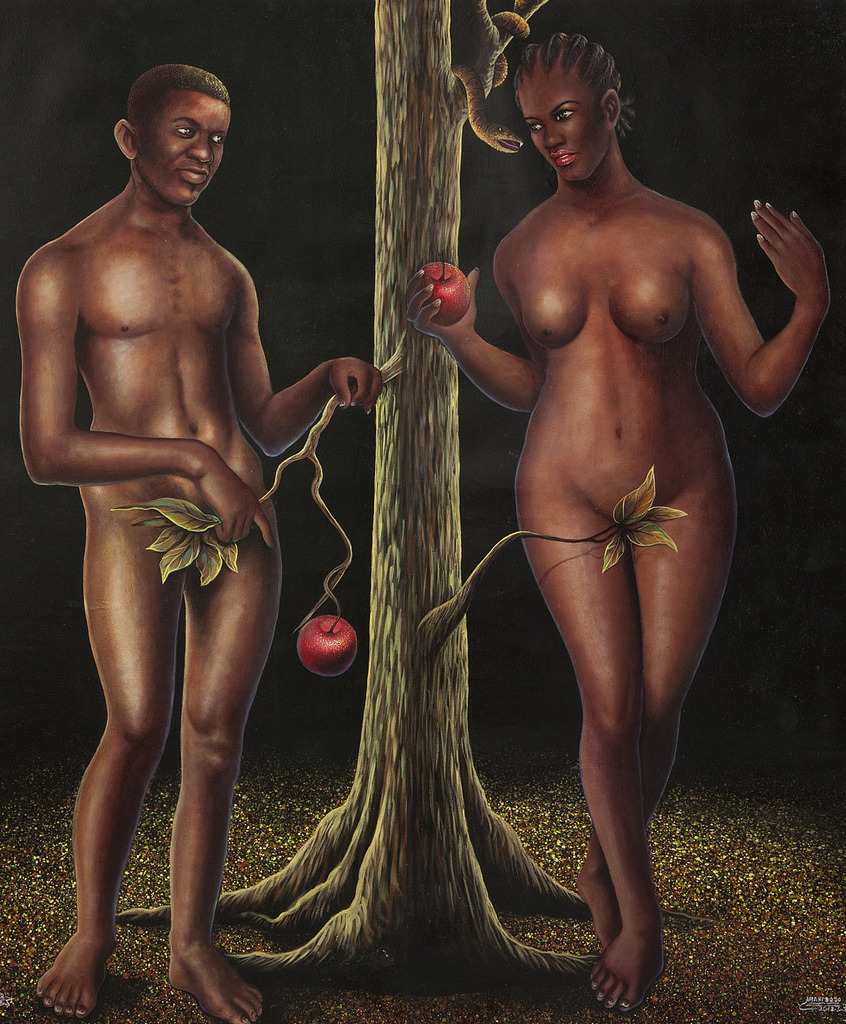 Long before this, we are told in the Judaic creation myth, the God Yahweh created a man, placed him in a garden in Eden, and instructed him, "You may freely eat of every tree of the garden; but of the Tree of the Knowledge of Good and Evil you shall not eat, for in the day that you eat of it you shall die."† After a time, seeing that the bachelor could not manage alone (that shouldn't have taken long), God created woman. The man and the woman – Adam and Eve – lived on in the garden, collecting nuts and fruits from the permitted trees. Their lives were simple but not dull, because they didn't have the capacity to sense "dull", any more than the eloi would have.
† All quotes are Biblical citations from the Book of Genesis, chapters 2 and 3, Revised Standard Version.
Then one day Eve is approached by a talking serpent, perhaps not unusual at the time. Is it really so, asks the serpent, that God has forbidden them to eat of any tree in the garden? Well, says Eve, we may eat what we want, except that God has commanded, "You shall not eat of the fruit of the tree which is in the midst of the garden, neither shall you touch it, lest you die." Now this is not quite what God had told Adam before Eve was created; Eve evidently got her instruction second-hand from Adam. Adam has added the warning to not even touch the tree, probably to reduce the likelihood of Eve straying, in light of the threatened punishment of death. And Eve only knows it as "the tree which is in the midst of the garden." Adam has left out the name of the tree!
But now the secret of the tree is revealed to Eve: "God knows," says the serpent, "that when you eat of it your eyes will be opened, and you will be like God, knowing good and evil." This is news to Eve. The fruit of the tree will give moral knowledge! Why hasn't Adam told her this? He is clearly satisfied with life in the garden, with their everlasting, carefree existence. Perhaps he kept the secret of the tree from her because he sensed in her less of a propensity to acquiesce in their docile existence, sensed perhaps a dangerous curiosity, a restlessness, perhaps even a thirst for knowledge – heaven forbid.
The new information from the serpent fell on fertile ground, and Eve acted resolutely: "So when the woman saw that the tree was good for food, and that it was a delight to the eyes, and that the tree was to be desired to make one wise, she took of its fruit and ate, and she also gave some to her husband, and he ate." [Emph. added.]
God had made man and woman as non-moral beings, with no knowledge of right and wrong. They were thus not capable of sin, but were free to choose to obey or ignore God's single rule on the basis of its merits. Confronted with this choice, passive Adam intended obedience, while Eve considered the alternatives:
1. Continue in the status quo of an unending existence as non-moral beings, without conflict and fully provided for, without responsibility or difficult choices, but also unable to affect their own lives, unable to cogitate beyond deciding which fruit to pick.And Eve made her decision, the bravest and most momentous single decision in human history. She would choose the quest for knowledge over unending eloi-dom.
Or
2. An unknown life imbued with uncertainty and terminated by death, weighed by an awful responsibility for themselves and their descendants, but enriched by wonder, curiosity, ideas, and perhaps knowledge and understanding.
Research in anthropology and genetics indicates that the modern human species arose (i.e., separated from related species) in eastern Africa – apparently the site of the garden – during a period from 200 to 100 thousand years ago. Among the major questions remaining for researchers is the timing of what they sometimes term (with a nod to Mao) "the great leap forward". By this they mean the critical phase of development that gave us our most distinctly human qualities: the powers of speech and cogitation, the ability to consider and make moral choices. This great leap has been placed by researchers (rather roughly) at between 200 and 75 thousand years ago.
The Jewish creation story is the parable of this emergence of mankind, and the tale of the garden of Eden tells us of the "great leap forward," with Eve as its chief instrument. Eve, in the Hebrew legend, made the choice that lifted our species up to full humanity. Eve was our first seeker after knowledge, our first philosopher. But she was no mere theorizer. She was a woman not afraid to act, even if it meant civil disobedience, even if the penalty was death. The first social activist, she literally bet her life on the potential for the human species to make its own moral choices.
So what has happened to this first and greatest of human heroes, this woman of Africa whose brave act of defiance represents the lifting of our species from pre-human dull-wittedness to full humanity? Who has sullied her reputation and made her the paradigm of sin? We all know the answer. The priestly class, the spiritual authoritarians claiming monopoly on moral truth for God's flock of sheep, could not permit Eve, the ultimate spiritual rebel, to be celebrated as a symbol of free thought and moral self-determination, of rejection of mental strait-jacketing. She needed to be crushed and vilified, falsely stamped with the badge of "original sin" as she has been by the church for two thousand years. It is time for her restoration.
(For amusement, the reader may wish to ask a priest how Adam and Eve could have sinned when they hadn't yet eaten of the tree of knowledge of good and evil – they didn't yet have moral knowledge – they didn't know right from wrong. The priest will not have heard this objection before, and the theological gymnastics required for an answer will be found entertaining.)
Eve not only gave us our birth, nor only gave us knowledge; she showed us how to live freely and bravely, preferring the risks of protest and uncertainty – but with the rewards of freedom – to a life in the unthinking flock. In the story of Eden, Adam was the obedient sheep, satisfied with being cared for; Eve was the daring eagle who gave us wings. As our first and greatest hero, as the originator of full humanity, this secular saint deserves our celebration and emulation.
